
Case study — Art & E-Commerce
Queen Nwaneri is a painter with two decades of practice, an exhibition record from Lagos to Queensland, and no way for anyone to buy her work without going through a gallery. We built the studio a storefront — and took a stake in whether it works.
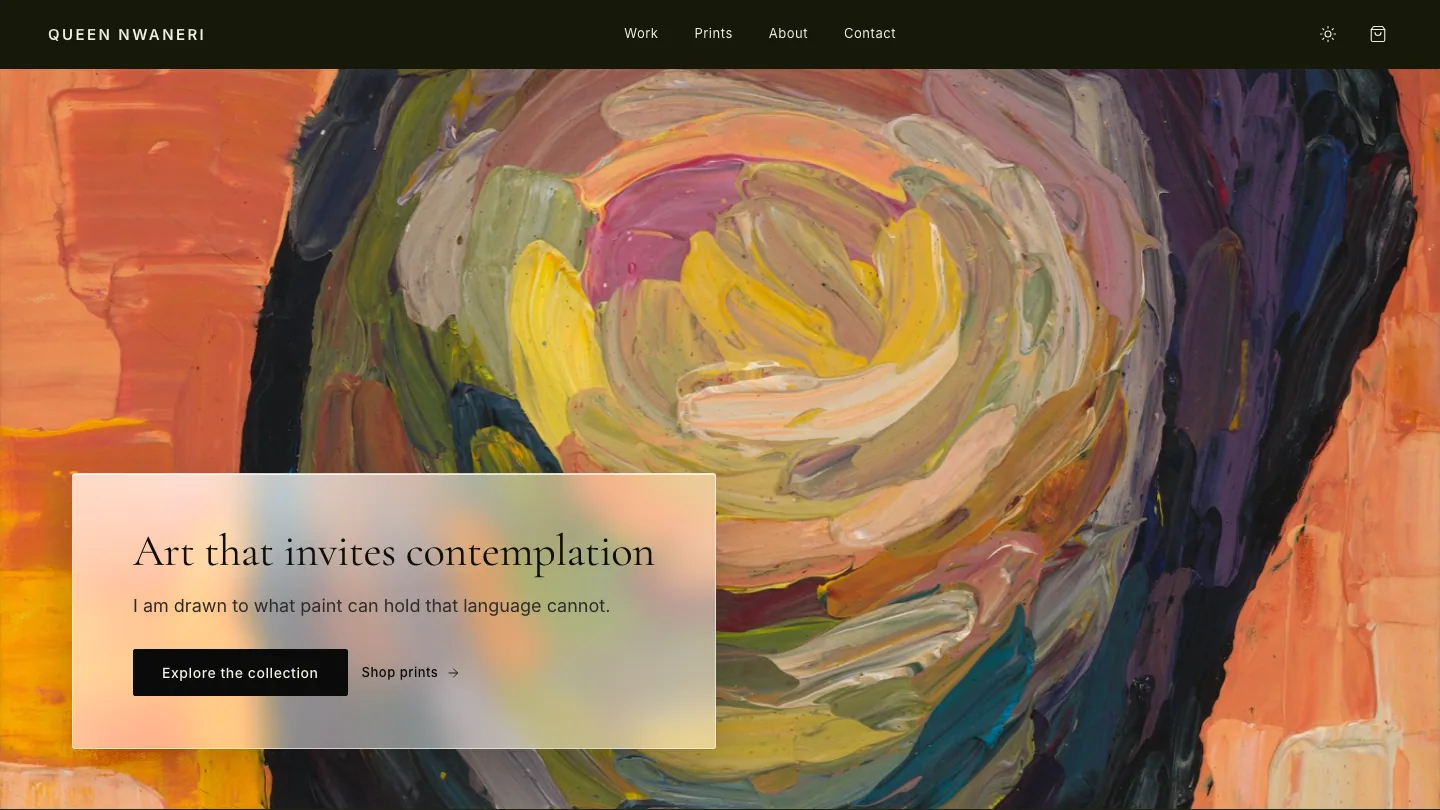
11
Works catalogued and photographed
792
Orderable print configurations
3
Revenue streams from one site
0
Units of inventory held
The problem
A strong catalogue with no way to buy it. Galleries took a large cut; Instagram had no checkout.
What we built
A storefront selling originals, made-to-order prints, and commissions — no stock held.
The deal
Built on revenue share, and still run by us. Queen paints; we run the shop.
- Client
- Queen Nwaneri, painter
- Studio
- Queensland, Australia
- Engagement
- Design, build, and ongoing management
- Model
- Partnership — revenue share
- Year
- 2026
The opportunity
Queen trained at the Nike Art Centre and Obafemi Awolowo University, exhibited at Art X Lagos and Rele Gallery, and placed first runner-up in the Mastercard Art Foundation prize. The work and the record were there.
What was missing was a way to sell. Galleries take a large commission and decide what gets shown. Instagram creates interest but has no checkout — so every enquiry became a manual conversation about size, shipping, and payment, and most quietly ended.
The problem was never visibility. It was that interest had nowhere to convert.
The constraint we designed around
An artist's income is capped by how fast they can paint — unless the work can be sold more than once.
Everything that follows exists to lift that ceiling — without costing Queen an hour away from the easel.
Why we partnered
Most artists can't fund a custom build up front, and most agencies won't work without that fee. So serious artists end up on a template that fights their work — or with nothing.
We took a share of the revenue instead. Not charity: a judgement about the asset. Strong catalogue, real exhibition record, and a print model that turns a finite set of paintings into a repeatable product line.
It changes how you build. When your return depends on the site converting, you care about the checkout — and about what happens in month six.
The artist keeps the upside
No large fee before a single sale. The build is carried against future revenue.
Incentives point the same way
We're paid when the site sells — so we care about conversion, not billable hours.
No handover and goodbye
We keep running it. No artist gets handed a codebase and left to manage payments alone.
A model we can repeat
The print engine transfers to any artist with a catalogue. The next build starts far ahead.
How we worked
01
Catalogued the work
Every painting photographed, measured, and recorded — medium, size, year, status.
02
Priced the originals
Set against Queen's exhibition history and the Australian market. Real prices on the page — no "price on application".
03
Built the print engine
The commercial unlock: real choice for buyers, without holding stock or quoting by hand.
04
Designed around the paintings
Where a design idea competed with a painting for attention, the design gave way.
05
Wrote in Queen's voice
Drafted from her own words and edited for the web — not replaced with marketing language.
06
Kept running it
Hosting, payments, new work, price changes. Queen paints; we run the shop.
Design thinking
An artist's site has a conflict built into it: the interface and the artwork compete for the same attention, and only one of them is for sale.
So the design stays quiet. Narrow palette, one accent, and anything that couldn't justify itself against a painting was removed.
“I work with palette knife as a form of expression to create texture, vibrant colour, and atmospheric abstraction.”
The work is the interface
Deep olive ground, wide margins, almost no chrome. Paintings get the room they'd get on a gallery wall.
Serif for art, sans for shopping
Titles and Queen's voice in a literary serif; prices and buttons in a plain sans. You always know who's speaking.
Dark by default, light by choice
Olive makes the impasto and gold leaf read as they do in person. Prefer a white wall? One tap, and it remembers.
No dark patterns
No fake scarcity, no email popup before you've seen a painting. Hard-sell would contradict the work.
Structure
Visitors arrive with very different budgets. A collector after an original, someone who wants a print for the hallway, and a client wanting a commission each find their route within one click — and none of them has to understand how the studio works.
| Tier | Price | How it works |
|---|---|---|
| Originals | AU$500 – AU$4,000 | One-of-one. Priced on the page, purchasable directly. |
| Open-edition prints | From AU$49 | Made to order in 8 sizes and 9 materials. No stock, no risk, printed after purchase. |
| Limited editions & commissions | Quoted | Enquiry-driven, routed to the studio inbox. High-value work that deserves a conversation. |
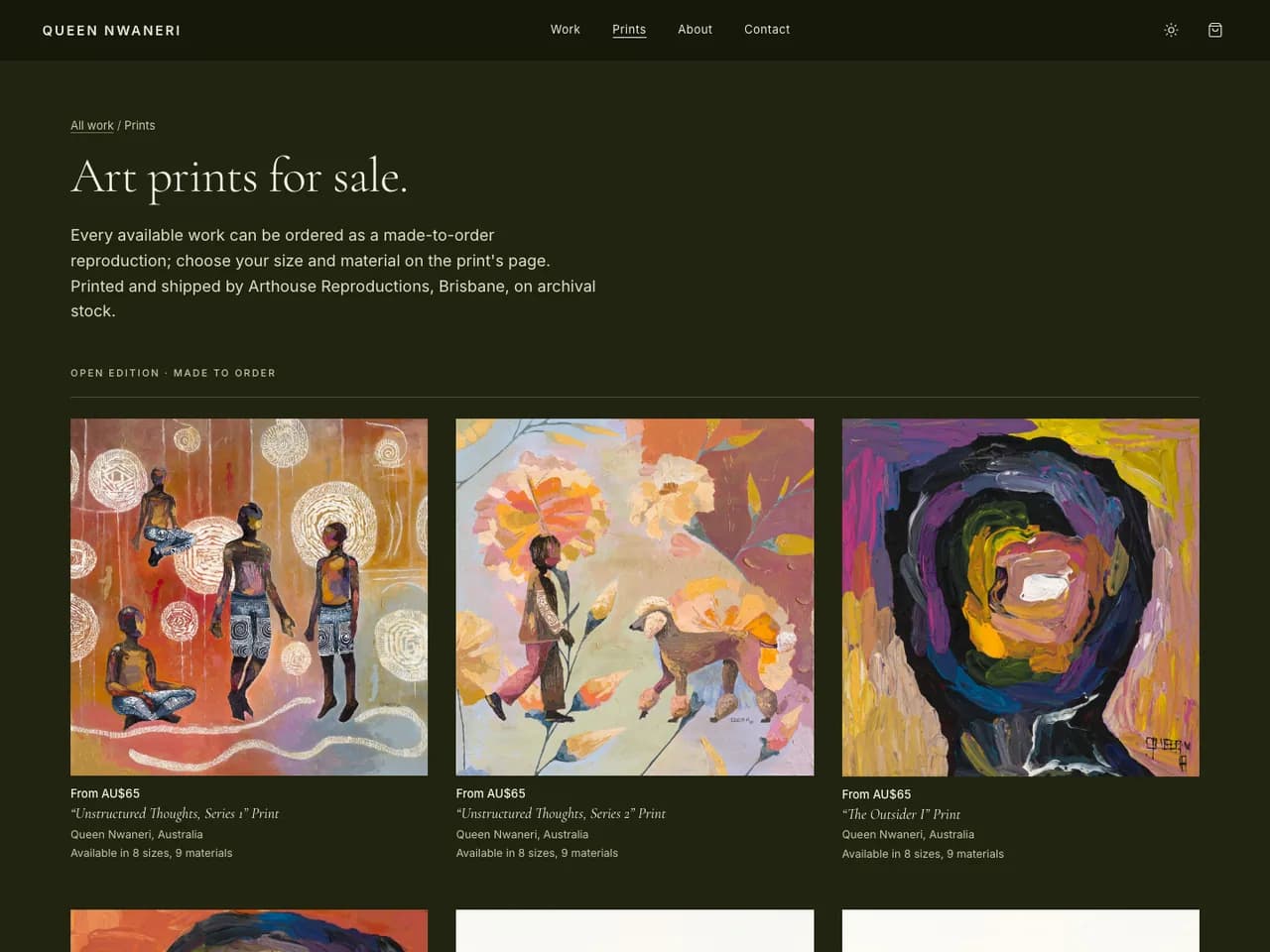
Every work carries a visible starting price. Nothing requires an enquiry to discover what it costs.
The commerce engine
Every painting is sold as a made-to-order print in eight sizes and nine materials — 72 combinations per work, 792 across the catalogue. None exist until someone buys one.
Pricing was the hard part. The printer resizes by fixed height, so every artwork's shape produces a different width — and a different cost — at every size. Quoting that by hand per painting would never have scaled.
So we reverse-engineered the printer's cost model from their own quote sheets, checked against 150+ figures with a worst-case error of 0.02%.
Queen adds a painting; its entire print range prices itself instantly, at any shape, size, or material.
Retail = printer cost × 3
One markup constant governs the whole catalogue. Margin is deliberate, not guessed.
Orders carry the exact spec
Buyers see “Cotton Rag — Textured”. The order says “Textured Cotton Rag 320gsm”, so the printer can't mistake it.
Cards, Apple Pay, Afterpay, PayPal
Buy-now-pay-later matters at the AU$300–800 print price point.
Fails safely
If payments ever go down, checkout says so plainly and enquiries fall back to email rather than vanishing.
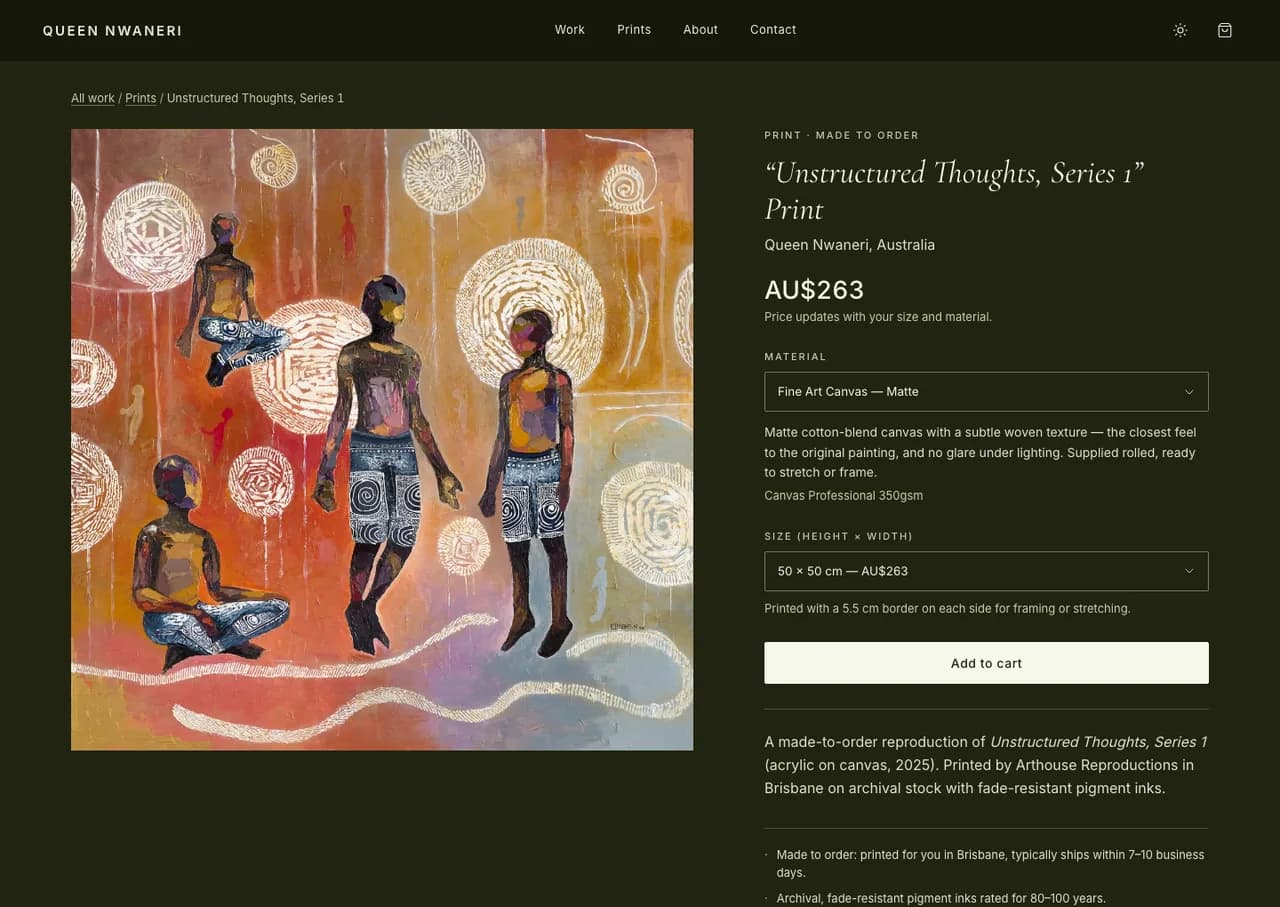
The price updates live as the buyer chooses. Every size in the dropdown shows its own price, so nobody has to click to find out.
Marketing copy
Art buyers are sensitive to tone. Overselling cheapens the work, and a collector can tell an artist's sentence from a marketer's instantly.
So the voice is Queen's — her statement, her training, her own account of what light and rivers mean in the work. Edited for the web, not rewritten.
Product copy does a different job: it removes doubt. Print buyers quietly worry about quality, so materials are described for someone who has never bought a print before.
Instead of a spec sheet
“The closest feel to the original painting, and no glare under lighting. Supplied rolled, ready to stretch or frame.”
Canvas Professional 350gsm
Objections answered before they are raised
- Made to order, printed in Brisbane, typically ships in 7–10 business days.
- Archival pigment inks rated for 80–100 years.
- Paper ships flat and board-backed; canvas and acrylic ship boxed.
After launch
A storefront isn't a deliverable, it's an operation. Prices change, printers revise rates, payment providers change APIs, new paintings come off the easel. An artist shouldn't have to become a systems administrator to keep selling.
So we run it. Queen sends photographs and a price; the work appears, catalogued, with its full print range live.
We kept the build deliberately simple to make that sustainable — which keeps the running cost near zero, and that matters when a revenue share has to cover it.
New work
Photographed, catalogued, priced, published.
Print pricing
Re-derived when the printer revises rates.
Payments
Stripe and PayPal monitored; methods tuned.
Fulfilment
Orders arrive with exact printer specs.
Performance
Image sizes and page weight kept in check.
Growth
Studio letter, editions, and commission funnel.
The growth model
The site launched recently, so the revenue is ahead of it rather than behind it. What we can state plainly is the structure.
Originals are high-value but finite — they fund the studio and can't compound. Prints are the opposite: unlimited supply, no inventory risk, and from AU$49 so someone who could never spend AU$4,000 can still own the work.
Each tier feeds the next. A print buyer joins the studio letter; a subscriber sees the next original; an original buyer commissions a portrait. That ladder — not any single sale — is the asset.
What we will report on
- Print orders and average order value
- Original sales attributed to the site
- Commission and limited-edition enquiries
- Studio letter subscribers
We'll update this page with real results as they come in, rather than publish numbers the site hasn't earned.
In the client's words
“The team handled the delivery of the project efficiently. Every technical design was handled with precision, with very little input needed. My website was finished in under three weeks, which was impressive.”
We partner with a small number of artists and founders each year, including on revenue-share terms where the work justifies it.
Contact
Kickstart your project
Tell us what you're building — even if it's still just an idea. We'll read it and get back to you personally.